


Renault Group boekt robuuste omzet in derde kwartaal conform financiële prognose 2026

- Sterke operationele fundamenten en een gedisciplineerde implementatie tonen waarde van futuREady in de praktijk
- Omzet eerste negen maanden 2026:
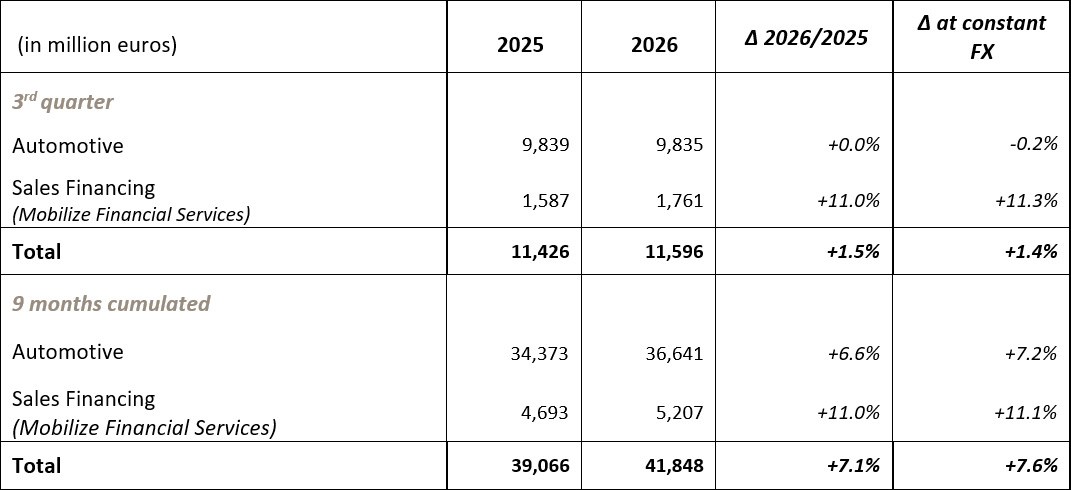
- Groepsomzet van € 41,8 miljard, +7,1% ten opzichte van de eerste negen maanden van 2025, +7,6% tegen constante wisselkoersen¹
- Automotive-omzet van € 36,6 miljard, +6,6% ten opzichte van de eerste negen maanden van 2025, +7,2% tegen constante wisselkoersen¹
- Omzet van Mobilize Financial Services (MFS) van € 5,2 miljard, +11,0% ten opzichte van de eerste negen maanden van 2025, +11,1% tegen constante wisselkoersen¹
- Omzet derde kwartaal 2026:
- Groepsomzet van € 11,6 miljard, +1,5% ten opzichte van het derde kwartaal van 2025, +1,4% tegen constante wisselkoersen¹
- Automotive-omzet van € 9,8 miljard, +0,0% ten opzichte van het derde kwartaal van 2025, -0,2% tegen constante wisselkoersen¹
- Omzet van MFS van € 1,8 miljard, +11,0% ten opzichte van het derde kwartaal van 2025, +11,3% tegen constante wisselkoersen¹
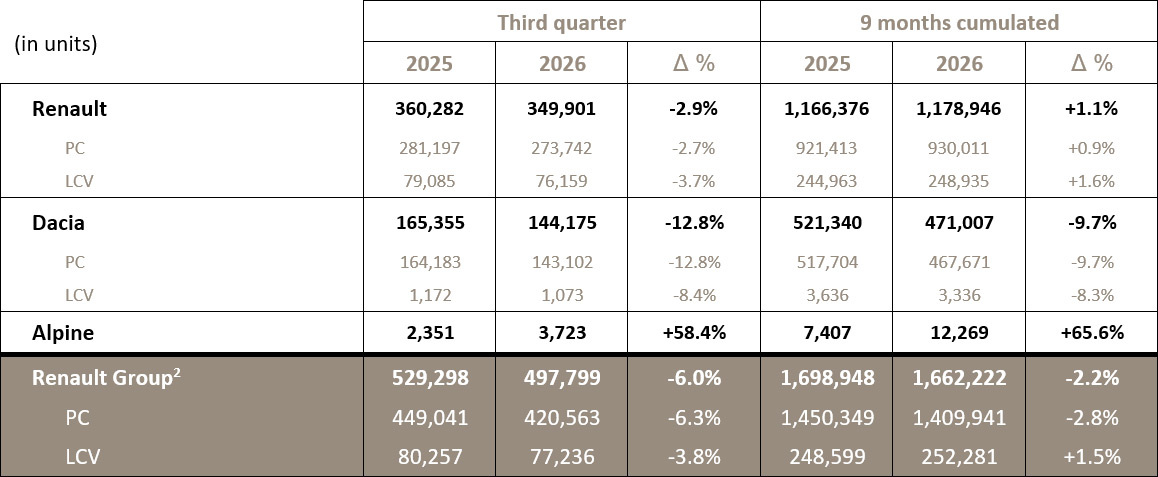
- In de eerste negen maanden van 2026 verkocht Renault Group 1,662 miljoen auto’s, een lichte daling van 2,2% op jaarbasis, waarmee de veerkracht van het concern in een zeer concurrerende markt wordt onderstreept. De verkoop van het merk Renault steeg met 1,1%, ondersteund door een vernieuwd en steeds verder geëlektrificeerd modellengamma. Hierdoor klom het merk naar de tweede positie in Europa². De verkoop van Dacia daalde met 9,7% als gevolg van een overgangsfase in het product- en aandrijflijnaanbod, tegen de achtergrond van een sterk toenemende vraag naar elektrische auto’s. Alpine groeide met 65,6%, vooral dankzij de A290.
- In het derde kwartaal van 2026 daalde de verkoop van Renault Group met 6,0%, als gevolg van uiteenlopende merk- en regionale ontwikkelingen. De verkoop van het merk Renault daalde met 2,9%, terwijl de verkoop op de totale markt in Europa met 4,6% toenam. De verkoop van Dacia lag in deze periode 12,8% lager, mede door de vergelijking met een buitengewoon hoog resultaat in het derde kwartaal van 2025. Alpine hield vast aan zijn sterke groeitempo met een verkoopstijging van 58,4%.
- Renault Group paste zijn commerciële en industriële activiteiten snel aan op de versnelde groei van de vraag naar elektrische auto’s in Europa. De verkoop van EV’s³ steeg in het derde kwartaal van 2026 met 84,7% ten opzichte van een jaar eerder. Daardoor nam het aandeel EV’s in de totale verkoop van de Groep met 12,2 procentpunt toe tot 25,8%. Inclusief HEV- en PHEV-modellen⁴ vertegenwoordigden geëlektrificeerde modellen 54,9% van de verkoop van personenauto’s van de Groep in het derde kwartaal van 2026.
- Renault Group handhaafde in dit kwartaal een strikte waardegerichte aanpak. De retailverkoop in Europa steeg met 5,0% en het aandeel retailverkoop nam met 4,6 procentpunt toe tot 64,8%. Tegelijkertijd nam de invloed af van verkoopkanalen die minder waarde genereren: de verkoop van short-term rentals en demonstratieauto’s daalde met 18,0%. De restwaardes bleven 5 tot 13 procentpunt boven het marktgemiddelde.
- De totale voorraden bleven op een gezond niveau (532.000 auto’s per 30 september 2026), terwijl het Europese orderboek gevuld was voor circa twee maanden toekomstige verkoop.
- Renault Group zet zijn productoffensief in de tweede helft van 2026 voort met een volledig geëlektrificeerd aanbod: Renault Megane E-Tech electric, Renault Trafic E-Tech electric en Duster E-Tech hybrid voor Renault, plus Sandero Hybrid, New Spring en Striker voor Dacia.
- Ondanks een uitdagende marktomgeving zit Renault Group op koers voor zijn financiële vooruitzichten voor 2026:
- Een operationele marge van de Groep van circa 5,5% van de groepsomzet. Zoals aangegeven bij de financiële resultaten over de eerste helft van 2026 verwacht de Groep in de tweede helft van het jaar een lichte verbetering van de marge ten opzichte van de eerste helft. De gebruikelijke seizoensgebonden verbetering zal naar verwachting echter minder uitgesproken zijn dan in voorgaande jaren door hogere grondstofkosten en inflatie.
- Een automotive free cash flow van circa € 1,0 miljard.
¹ Om de ontwikkeling van de geconsolideerde omzet tegen constante wisselkoersen te analyseren, herberekent Renault Group de omzet van de verslagperiode met toepassing van de gemiddelde wisselkoersen van de voorgaande periode.
² Europa volgens de ACEA-definitie.
³ Personenauto’s in Europa.
⁴ Inclusief hybride (HEV) en plug-in hybride (PHEV) personenauto’s, exclusief mild hybride (MHEV).
Dit persbericht gaat verder in het Engels.
“Renault Group delivered resilient Q3 revenue, once again demonstrating the strength and agility of our operating model. Our competitive advantages are built on three complementary brands, a highly utilized and flexible industrial footprint, a strong dealer and aftersales network and our leading financial captive, Mobilize Financial Services. Together, these strengths enable us to adapt swiftly to evolving customer demand while protecting value through disciplined growth, rigorous inventory management, and a clear focus on high-quality sales channels and residual values.
This agility was particularly evident in Q3 as we successfully adapted to Europe’s fast-shifting energy mix, leveraging our dual EV and hybrid strategy along with the efficiency of our manufacturing & supply chain setup.
Combined with our strong product offensive and relentless execution of our cost‑reduction efforts, these fundamentals are at the core of futuREady and reinforce our confidence in achieving our 2026 financial guidance.” said Duncan Minto, Chief Financial Officer of Renault Group.
Boulogne-Billancourt, October 29, 2026
Commercial results highlights
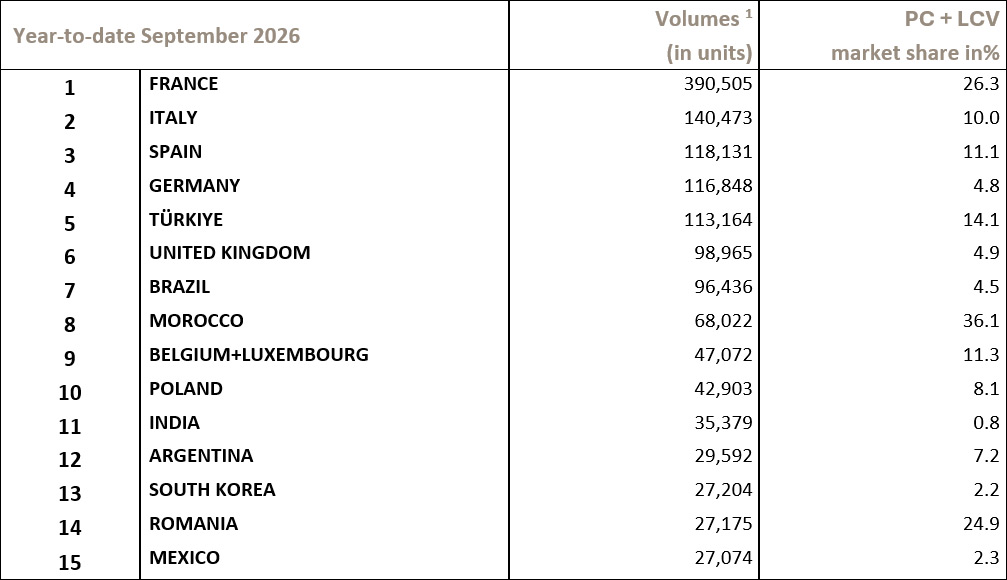
Over the first nine months of 2026, Group sales totalled 1,662,222 vehicles, slightly down 2.2% compared with the same period in 2025. This headline reflects contrasted brand and regional dynamics. In Europe, passenger car sales declined by 3.1%, but increased by 6.0% in Northern Europe[1], supported by strong growth in Germany (+8.6%), the United Kingdom (+3.8%) and Denmark (+24.2%). The Group continued to improve the quality of its sales, with nearly six out of ten passenger cars sold to retail customers, while further accelerating its transition towards electrification. With sales up 59.4%, electric vehicles now account for 20.9% of passenger cars sold. Light commercial vehicle (LCV) sales confirmed their recovery, rising by 7.7% in a market up 1.1%. Internationally, sales increased in the Group’s strategic markets, including India (+36.7%), Türkiye (+3.2%), Morocco (+6.9%) and Brazil (+3.8%).
In the third quarter of 2026, against a backdrop of fierce competition, Renault Group sales totalled 497,799 vehicles, down 6.0%. Yet in Europe the Group further improved the quality of its sales, with almost two out of every three passenger cars sold to retail customers over the period. Renault Group’s EV sales grew even faster, rising 84.7% and accounting for 25.8% of passenger cars sold. Internationally, sales performance was affected by challenging conditions in several key markets. In Türkiye, Group sales declined by 18.0%, outperforming a market down 23.3%. In Latin America, the Group faced intense competition, with additional pressure in Argentina while the local market faced a 19.2% decline.
From a product perspective, the continued rollout of Renault’s international line-up, including the launch of the Niagara pick-up, together with the ongoing success of the brand’s electric models in Europe, the launches of the Dacia Sandero Hybrid, the new Dacia Spring and the Dacia Striker, as well as the Alpine A290, will support the commercial performance in the fourth quarter of 2026.
Renault brand – Sales up, driven by electrification, LCVs and growth in key markets
In the first nine months of 2026, Renault sold 1,178,946 vehicles worldwide, up 1.1% year-on-year. Performance was balanced across passenger car sales, increasing by 0.9% to 930,011 units and LCV sales, rising by 1.6% to 248,935 units. Europe remained a key growth driver, with sales up 3.1%, lifting Renault to second place in the market year-on-year.
Renault continued to accelerate electrification in Europe through its complementary EV and full hybrid strategy. Electrified vehicles represented 68.0% of the brand’s passenger car sales at the end of September (up 8.6 points) and EV sales increased by 75.2%, supported by the success of its renewed line-up. Twingo E-Tech electric has recorded nearly 26,000 sales since its launch and already ranks #1 in its segment[2].
Alongside volume growth, Renault maintained its value-driven commercial policy, with a continued focus on retail performance, profitable channels and residual-value protection. European PC retail sales grew nearly twice as fast as the market, rising by 20.2% versus 10.7%, with retail market share up 0.5 points.
LCVs remained a key pillar of Renault brand performance, with 192,367 vehicles sold in Europe in the first nine months of 2026. With sales up 8.1%, the brand outperformed the market growth of 1.1% and gained 0.9 points of market share. Kangoo Van and Trafic Van ranked on the podium, while Master led the large-van segment. Renault also strengthened its position in electrified LCVs, with sales up 22.9% at the end of September.
International markets accounted for 36.0% of Renault’s global sales, with 424,915 vehicles sold outside Europe. The brand recorded strong growth in several key markets, including India (+36.7%), Mexico (+17.1%), Colombia (+8.4%), Brazil (+3.8%), Morocco (+3.3%), and Türkiye (+11.6%) where Renault strengthened its position as the country’s leading automotive brand despite a declining market.
In the third quarter of 2026, Renault demonstrated resilience in a challenging global market, selling 349,901 vehicles worldwide despite intense competition in Latin America, market downturns in Türkiye, Argentina and South Korea, and ongoing geopolitical tensions. In Europe, Renault maintained positive momentum, with passenger car sales rising by 6.3%, reflecting the brand’s sustainable performance in the region.
Looking ahead, Renault will pursue its product offensive and electrification strategy, with Duster E-Tech hybrid, Boreal and Niagara driving its international offensive, alongside Twingo E-Tech electric and new Megane E-Tech electric in Europe. In LCVs, the upcoming Trafic Van E-Tech electric will broaden the brand’s offering into the medium-van segment, opening up further growth opportunities.
Dacia brand – Gearing up for its upcoming product offensive
In the first nine months of 2026, Dacia sold 471,007 vehicles worldwide, down 9.7% year-on-year. Dacia remained disciplined in its focus on the retail market, with positive results: 74.9% mix in Q3, firmly established on the European retail podium (3rd), while Sandero remained the best-selling passenger car in the European retail market. This demonstrates the continued strength of Dacia’s value-for-money proposition, as reflected in residual values that are 13 points above the market average. But this strength also made Dacia a target for increasing competition, notably from Chinese brands, and particularly in the C-segment, where Bigster competes.
The brand also benefits from three proven technologies offering highly competitive running costs: full hybrid powertrains with Dacia becoming 4th hybrid[3] brand in Europe (24.6% of Dacia sales), hybrid 4×4 weighing 15% of Duster and Bigster sales, and with LPG accounting for 39.2% of sales.
In the third quarter of 2026, Dacia sold 144,175 vehicles worldwide, down 12.8% year-on-year against a high comparison base in Q3 2025. This result came amid the rapid electrification of the European market, where sales of electrified vehicles rose sharply to reach a mix of 53.3% (up 10.3 points), while the brand was undergoing a transition in its product cycle.
Looking ahead to the fourth quarter, Dacia will benefit from the first European deliveries of Sandero HEV, New Spring and Striker, as well as a solid order portfolio, driven by a good order momentum in September. Thanks to these new models, Dacia is now a fully electrified brand. On the EV market, the European production of the New Spring will give access to all incentives therefore a greater commercial potential. Among full hybrid vehicles, Striker will offer the best fuel consumption and CO2 emissions performance of the C-segment. This will contribute to the brand’s momentum in the final quarter.
Alpine Brand – Growing across all its markets
In the first nine months of 2026, Alpine continued to scale rapidly, reaching 12,269 worldwide registrations, up 65.6% year-on-year and already above its full-year 2025 volume. Growth is increasingly broad-based across Europe, with particularly strong year-to-date performances in France (+44.7%), the UK (+193.5%), Germany (+62.6%) and Spain (+91.1%). As a result, the brand’s sales outside France now account for 54.7% of total sales, up 6.5 points year-on-year. At the heart of this momentum is the Alpine A290, with 8,618 registrations worldwide (+54.2%) and more than 10,000 European orders, an all-time order record at the end of September. The Alpine A390, now available in GTS version, is progressively adding a second pillar to Alpine’s electric expansion, with nearly 1,800 registrations since the start of the year.
In the third quarter of 2026, September provided another milestone for the brand, delivering its best-ever month for EV orders and its second-best overall order month, confirming the strength of Alpine’s ongoing transformation and supporting continued revenue growth.
2026 Third quarter revenue
Group revenue amounted to €11,596 million, up 1.5% compared to 2025 Q3. At constant exchange rates, Group revenue was up 1.4%.
Automotive revenue reached €9,835 million, stable compared to 2025 Q3. It included 0.2 points of positive exchange rates effect (+€14 million) mainly related to the appreciation of the Brazilian real and of the Columbian peso, partly offset by the depreciation of the Turkish lira. At constant exchange rates, it decreased by -0.2%. This evolution was mainly explained by the following:
- A negative volume effect of -5.9 points, mostly due to the -6.0% decrease in registrations. As of September 30, 2026, total inventories of new vehicles represented 532,000 vehicles, of which 312,000 at independent dealers and 220,000 at Group level. Renault Group expects total inventories to trend towards the lower end of the 525,000 to 550,000 units range at the end of 2026.
- A strong positive sales to partners effect of +4.9 points, driven primarily by:
- The performance of Geely partnership in Brazil, with the ramp-up in the distribution of its vehicles, as well as the start of their production since September,
- The integration of RNAIPL[4] since August 1st, 2025 in the consolidation perimeter, which contributed +€165 million in 2026 Q3 compared to 2025 Q3 (+1.7 points).
- A solid product mix effect of +2.3 points, mainly attributed to the transition phase between Clio V and Clio VI (Clio VI having a better average selling price than Clio V, while still below Group’s average), LCV (Master and Trafic) and the success of electric vehicles.
- A positive price effect of +1.1 points, as price increases to compensate for FX on international markets were partly offset by price pressure in Europe. The high-trim EV battery mix coupled to HEV powertrain mix supported a positive enrichment effect in the third quarter.
- A positive geographic mix effect of +0.5 points, mainly explained by the sales increase in France and Germany alongside a lower exposure to sales in Argentina during 2026 Q3 compared to 2025 Q3.
- A negative “Other” effect of -3.1 points, mainly reflecting the impact of Retail Renault Group (RRG) inventory normalization following a particularly low inventory level at the end of June 2026. RRG inventory level at the end of September 2026 was back to previous’ year level.
Mobilize Financial Services (formerly RCI Bank and Services) reported Q3 2026 revenue of
€1,761 million, up 11.0% year-on-year, reflecting both higher interest rates and continued growth in average performing assets, which increased to €62.5 billion (+5.0% vs. Q3 2025).
2026 FY financial outlook
In a challenging environment, Renault Group confirms its 2026 financial outlook:
- Group operating margin around 5.5% of Group revenue. As stated in 2026 H1 results, the Group expects a slight margin improvement in H2 vs. H1, with the usual seasonal uplift expected to be less pronounced than in previous years due to higher raw material costs and inflation.
- Automotive free cash flow around €1.0 billion.
Renault Group’s consolidated revenue
1 In order to analyze the variation in consolidated revenue at constant exchange rates, Renault Group recalculates the revenue for the current period by applying average exchange rates of the previous period.
Renault Group’s top 15 markets at the end of September 2026
1 Excluding Twizy.
Total Renault Group PC + LCV1 sales by brand
1 PC +LCV: passenger cars + light commercial vehicles.
2 Including RKM in 2025.
2026 Q3 revenue conference
Link to follow the conference at 8am CET on October 29, and available in replay:
2026 Q3 revenue conference
[1] Northern Europe = Denmark, Finland, Germany, Iceland, Ireland, Norway, Sweden and The United Kingdom.
[2] Segment A electric, in Q3, Europe PC.
[3] HEV only (excluding PHEV).
[4] Renault Nissan Automotive India Private Ltd.